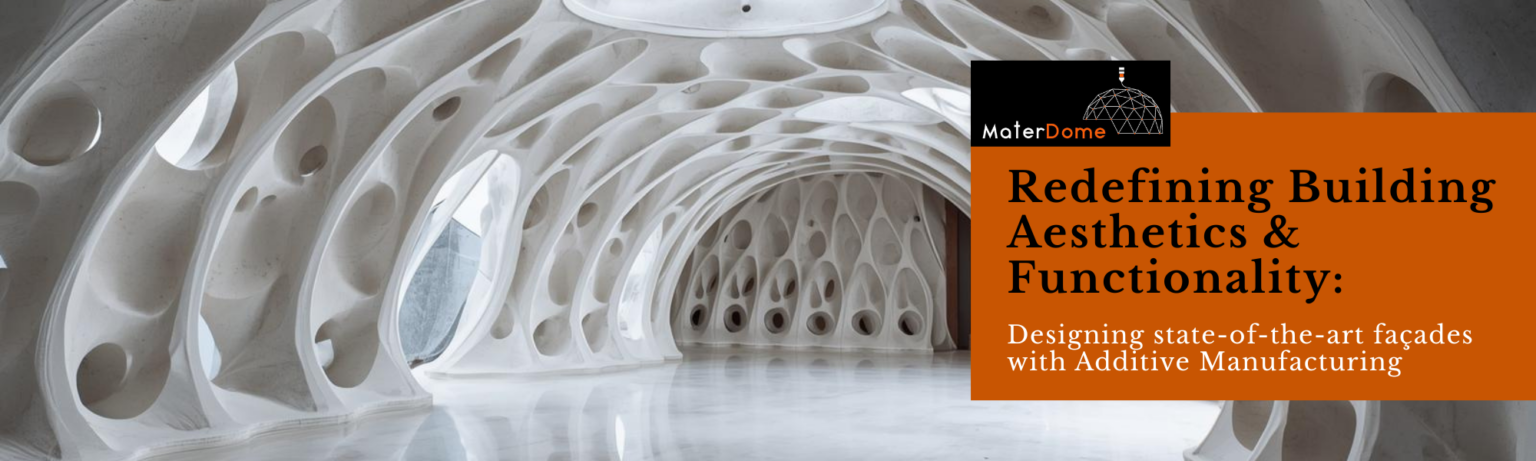
There is a saying that I believe is 100% true. This saying is that: “If you want to see the world’s future, all you need to do is to observe the expression of artists and architects.” Having that saying as a guide, most of the time, creatives try to conceptualize new trends by applying the latest technological capabilities and materials to imagine the vision of our society. So, the window to the future doesn’t lie in relying on or using the conventional ways, but in transforming the disruptive technologies and concepts into unbounded possibilities.
Additive manufacturing is revolutionizing how architects and engineers enable the creation of sophisticated façade systems for multifunctional building envelopes that seamlessly integrate aesthetic expression with high-performance capabilities. For companies positioned at the forefront of innovation, the opportunity to leverage large-format additive manufacturing represents a fundamental shift in how buildings are designed, fabricated, and installed.
For that reason, I have started looking and learning more about each aspect of fabricating and utilize AM technology for making our places look and actually better. There are lots of examples for clever, innovative and beautiful applications.
The Transformation of Building Envelopes
Traditional façade systems rely heavily on standardized panels, costly molds, and labor-intensive assembly processes that constrain architectural vision and inflate project timelines. The use of Additive manufacturing eliminates almost entirely most of these barriers, offering a fundamentally different approach to façade production. The deposition of material in a layer-by-layer manner according to computer-aided design specifications provides architects with unprecedented geometric freedom, reduces material waste, and accelerates the time-to-market.
This transformation extends beyond mere aesthetics. Modern façade systems can integrate multiple functions within a single monolithic structure. Proven examples are incorporated thermal performance, acoustic optimization, integrated sensing capabilities, and environmental responsiveness—all fabricated as a single, cohesive structure. Obviously, these new façade systems aren’t created only for their appearance but also to solve problems that have not yet been solved.
Three Paradigm-Shifting Façade Technologies
So, I have begun learning more about fabricating and using AM technology to enhance our spaces both visually and functionally. While there are numerous examples of clever, innovative, and beautiful applications, these particular ones have captured my attention.
1. Coral Reef Façade – Biomorphic Panels
Although this kind of façade is not designed to accommodate specific people’s needs, it is based on the organic complexity of coral ecosystems. These biomorphic panel systems introduce nature-informed design principles converted into functional architecture. Such panels have the inherent advantages of additive manufacturing, providing superior structural performance with complex surfaces in natural forms.
The Coral Reef Façade approach enables architects to design elements with gradient infill structures and parametrically optimized geometries, improving the adaptability of various sites. TU Eindhoven and Vertico created an example through their research and work on robotic 3D printing systems. They managed to develop delicate, double-curved lattice structures with elegant forms and minimal material consumption. These biomorphic panels have more than one role. They can be a screen, divider, structural element, and shading device, demonstrating how additive manufacturing overcomes functional boundaries.
Large-scale architectural installations, high-profile building envelopes, heritage restoration projects that require highly complex ornamentation, and premium commercial developments where design differentiation commands market value are the perfect applications for such panels.
2. Acoustic Diffuser Panel System project – Sound-Diffusing Panels
As urban environments grow increasingly complex, acoustic performance becomes a critical facade parameter. But traditional methods struggle to control the sound without compromising the architectural aesthetics. For that reason, this example of the acoustic system solves this challenge. The parametrically designed surfaces can diffuse sound waves while maintaining a visually sophisticated appearance.
Research led by Gramazio Kohler Research at ETH Zurich demonstrates the potential of acoustically optimized 3D-printed panels, specifically engineered for sound performance. The unique aspect of this design approach involves the development of double-curved panel surfaces with geometric patterns, optimizing acoustic performance parameters without increasing fabrication complexity or compromising aesthetic appeal.
The design process itself exemplifies AM’s problem-solving capability. Initially, 1:10 scale models were additively manufactured using sand to test the acoustic performance before finalizing the production design, enabling optimization based on real data. This is something impossible with conventional manufacturing.
Applications like these panels can be used in various locations, such as concert halls, performing arts venues, open-office spaces, hospitality and wellness spaces, broadcast and recording studios, and educational institutions, by prioritizing acoustic comfort and improving the sound experience.
3. ThermalPulse Radiant Façade – Microfluidic Panels
The need for advanced thermal management has emerged as an essential requirement for modern building performance. The new façade systems must be capable of regulating interior conditions while reducing mechanical HVAC demands. The “ThermalPulse” approach integrates fluidic channels directly within façade panels, enabling active thermal management through fluid circulation.
Research conducted at various universities, as the one conducted at TU Dresden, demonstrates the feasibility of functionally integrated thermal storage within 3D-printed façade elements using FDM-printed PETG materials. Systems like these incorporate an inner core optimized for thermal resistance, paired with outer layers containing phase-change materials or heat storage fluids, enabling buildings to store and release thermal energy dynamically throughout daily and seasonal cycles.
The integrated functionality of fluidic channels showcases a unique capacity to embed complex interior structures without increasing production costs—a capability that is impossible with traditional manufacturing methods. It has also been confirmed by computational simulations that even partial thermal management integration significantly reduces heating and cooling energy demands. Thus, operational cost savings and reduced greenhouse gas emissions are achieved.
As a result, high-performance commercial buildings, residential towers in composite climates, hospitality properties requiring precise temperature control, healthcare facilities, and even data centers greatly benefit from the new capabilities of advanced thermal management in their operational efficiency.
Strategic Competitive Advantages in Façade Manufacturing
These examples show that additive manufacturing, as I have been saying for several years, is a tool. What makes it better? The answer is simple: “Combine it!” Having additive manufacturing participate in a team with complementary methodologies. The result is the creation of a set of competitive advantages to improve the lives of people and the environment, without compromising the aesthetics and supercharging efficiency. Such methods are:
- Design for Additive Manufacturing (DfAM): Successful façade production requires a sophisticated design methodology, unlike the conventional architectural practice. Taking into account the DfAM principles makes it feasible for the engineer to address any manufacturability issues tied to the constraints of the specific additive system in use, optimize the internal structure for the designated performance (thermal, acoustic, structural), and leverage the existing parametric design tools to manage geometric complexity.
- Advanced Computational Design: Computational design enables the rapid development and iteration of designs based on site-specific conditions such as solar exposure, wind patterns, or views of the corridors. Research projects have demonstrated that computational tools reduce printing time by 48% through mesh or path optimization while maintaining structural performance. Show direct impact on production cost reduction and timeline compression.
- Integrated Prototyping: Iterative validation through full-scale or near-scale prototypes before committing to production reduces risk and enables performance optimization. For example, the Gramazio Kohler acoustic panel project exemplifies this approach. Using 1:10 scale models to perform acoustic testing before finalizing production designs ensured that the performance predictions could be translated to manufacturable components.
- Post-Processing Expertise: The last but not least advantage comes from a group of techniques used for surface finishing, structural integration, assembly optimization, and aesthetic refinement, which distinguish commodity production from premium systems. Specialized post-processing techniques address surface roughness, dimensional tolerance, color matching, and field integration requirements.
Bringing Innovation to Market: Pathway to Commercialization
The transition from experimental façade concepts to market-ready products requires navigating multiple challenges simultaneously.
Regulatory Alignment: Building regulatory frameworks in most European jurisdictions do not yet comprehensively address 3D-printed facades. Early-stage commercialization requires direct engagement with building authorities, regulatory officials, and performance certification bodies. An important consideration that MaterDome’s consulting expertise streamlines.
Supply Chain Development: Large-format (traditional or robotic) additive manufacturing capacity remains concentrated in specialized service bureaus and research institutions. Organizations seeking to build commercial facade businesses must communicate accurately, establish manufacturing partnerships, negotiate service agreements, and build redundancy to ensure reliable production capacity.
Market Positioning: Advanced façade systems command premium pricing when they deliver differentiated value—distinctive aesthetics, superior acoustic performance, integrated thermal management, or reduced maintenance requirements. Positioning façades as solutions to specific client challenges (campus redesign prioritizing student wellness, corporate headquarters emphasizing sustainability, hospitality venues requiring acoustic excellence) translates technological innovation into market demand.
As a founder, director, or even a senior engineer, if you do not build your leading team with process experts, experienced engineers, and well-trained data specialists who can ask the right questions and navigate challenges effectively, then Artificial Intelligence tools will offer no advantage to your processes, products, or manufacturing lines.
The Trajectory Forward
Additive manufacturing has progressed beyond experimental proof-of-concept to production-scale capability, yet the market remains in early adoption phases. Organizations that develop a sophisticated understanding of facade design methodology, select appropriate material platforms for their applications, invest in advanced design and optimization expertise, and navigate regulatory pathways will establish durable competitive advantages as the construction industry accelerates adoption of these transformative technologies.
The façade categories discussed represent the frontier of façade innovation. Each of them addresses distinct performance priorities while demonstrating additive manufacturing’s unique capacity to integrate complexity without proportional cost increases. For architects, engineers, and building owners prioritizing innovation, sustainability, and aesthetic distinction, these systems represent not distant possibilities but available solutions poised to define the next generation of exceptional buildings.
MaterDome's Supporting Capabilities for Façade Innovation
MaterDome, an additive manufacturing consulting and manufacturing firm with over 8 years of industry experience, empowers organizations to develop and commercialize advanced façade systems. The firm combines Design for Additive Manufacturing (DfAM) expertise with engineering and computational design methodologies, guiding clients through geometry optimization, material selection, and manufacturability assessment. Through in-house equipment and a network of manufacturing partners, MaterDome coordinates production workflows from ideation to making proof-of-concept and ultimately to commercial scale. The firm further supports material innovation through characterization services and strategic research partnerships, while providing technical guidance to funding via EU Horizon programs, national innovation funds, and ESA initiatives. Beyond technical execution, MaterDome delivers market analysis, regulatory guidance, and business development support—translating manufacturing innovation into competitive advantage and commercial success.